
The Golden Rule: Probate Is Not Automatically Mandatory
Probate is not triggered automatically simply because someone passed away. Whether your family needs court involvement depends almost entirely on how assets were titled, whether beneficiary designations were properly registered, the overall value of the estate, and state specific statutes. For many families, straightforward statutory shortcuts can save thousands of dollars and months of administrative delay.
When a family member dies, relatives are often told they must immediately open probate. That advice is frequently premature. While probate serves an important legal function when dealing with complex holdings or creditor disputes, many estates can be settled completely out of court.
By using small estate procedures, beneficiary designations, joint ownership arrangements, or a funded revocable living trust, families can often simplify or entirely bypass formal court proceedings. If you are also dealing with incoming bills and debt collectors, be sure to read our companion resource on the Family Guide to Money, Debt, and Scams After Death.
📑 Table of Contents
1. What Probate Actually Is (and Why It Exists)
At its core, probate is the formal legal process for settling a deceased person's financial affairs under the supervision of a state court. When someone passes away, their physical ability to sign contracts, transfer vehicle titles, and write checks ends. Someone needs recognizable legal authority to manage their property, pay legitimate bills, and distribute what remains to the rightful heirs.
If the deceased left a valid will, the court reviews the document, confirms its legal validity, and officially appoints the person nominated as the executor, frequently called the personal representative. If the person died without a will (known as dying intestate), the court follows state law to appoint an administrator and determine the heirs based on statutory lineage.
The Standard Probate Process Follows 7 Core Steps:
Filing the Initial Petition
The family member or nominated executor files the original will, death certificate, and petition with the probate court in the county where the decedent lived.
Issuing Letters of Authority
The judge issues official court documents known as Letters Testamentary (or Letters of Administration), granting the representative legal power to access accounts, sign deeds, and talk with financial institutions.
Inventorying and Appraising Assets
The personal representative locates, secures, and appraises all probate property, including real estate, individual bank accounts, vehicles, and personal valuables.
Publishing Notice to Creditors
State law mandates publishing a formal notice in a local newspaper and directly notifying known creditors, opening a statutory claim window (typically 3 to 6 months).
Settling Legitimate Debts and Taxes
The representative pays valid funeral bills, administration fees, court costs, and final personal and estate income taxes from estate bank funds.
Distributing Remaining Property
After debts and taxes are satisfied, the representative transfers the remaining balances, property deeds, and assets to the designated beneficiaries or statutory heirs.
Final Accounting and Court Closure
The representative submits a comprehensive final accounting of all receipts and disbursements to the court, receives approval, and the estate case is formally closed.
American Bar Association Perspective: The American Bar Association notes that the essential work of identifying property, paying legitimate debts, accounting for funds, and distributing balances must take place whether assets pass through court probate or through a private living trust. Avoiding probate simply changes the forum from a public courtroom to a private administrative process.
2. Which Assets Go Through Court vs Bypass It
One of the most widespread misunderstandings is that probate applies to everything someone owned. In reality, probate only governs assets that form the individual probate estate. How an asset was titled and whether a beneficiary was named determines whether it goes to court.
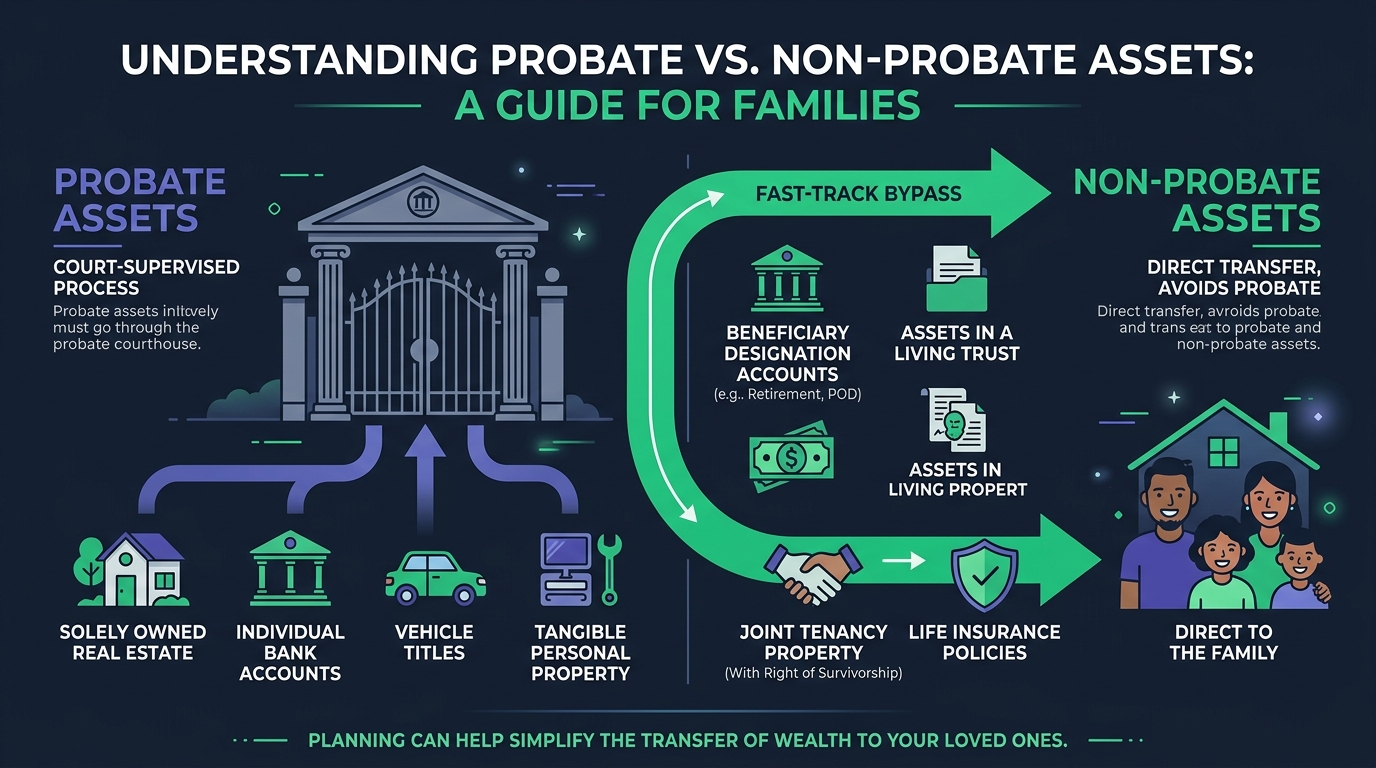
🏛️ Assets That Require Probate
Property held solely in the deceased person's individual name without automatic transfer designations:
- Solely Owned Real Estate: Houses, vacant land, or commercial properties titled only in the decedent's name.
- Individual Bank Accounts: Checking and savings accounts without a Payable on Death (POD) beneficiary.
- Individual Brokerage Accounts: Stock and mutual fund accounts lacking a Transfer on Death (TOD) registration.
- Vehicles & Boats: Titles held in the individual name with no transfer on death beneficiary.
- Tangible Possessions: Jewelry, artwork, furniture, firearms, and personal collectibles.
- Tenants in Common Real Estate: The decedent's percentage share of property co-owned without survivorship rights.
- Sole Proprietorship Interests: Business assets or partnership shares held personally.
⚡ Assets That Bypass Probate
Property with built-in legal mechanisms for immediate transfer upon presentation of a death certificate:
- Payable on Death (POD) Accounts: Bank accounts naming living beneficiaries.
- Transfer on Death (TOD) Securities: Investment portfolios naming direct transfer recipients.
- Joint Tenancy with Survivorship: Real estate or bank accounts owned jointly with rights of survivorship.
- Tenancy by the Entirety: Marital real estate owned with automatic survivorship protections.
- Life Insurance Proceeds: Policies naming specific individual beneficiaries.
- Retirement Accounts: 401(k), 403(b), and IRA accounts with valid beneficiary forms on file.
- Living Trust Property: Any real estate or accounts properly retitled into a revocable trust.
⚠️ Critical Fact: Beneficiary Designations Override Your Will
A will controls only probate assets. If a person writes in their will that all money goes to their daughter, but their $100,000 savings account has a Payable on Death designation naming a sibling, the bank will give the $100,000 directly to the sibling. The contractual beneficiary designation legally supersedes the terms of the will.
3. When Formal Probate Is Truly Unavoidable
While avoiding probate is often a helpful goal, opening a formal court case is sometimes necessary or even advisable. Formal probate provides clear judicial resolution in contentious or legally complex situations.
⚖️ Solely Owned Real Estate
Title companies require clear, marketable title before a buyer can purchase real estate. If a home is titled solely in the deceased owner's name, court issued Letters Testamentary are usually required to execute a valid deed of sale.
⚖️ Substantial Unsettled Debts
Probate establishes a hard statutory deadline (often 90 to 180 days) for creditors to submit claims. Once that window shuts, late claims are permanently barred, protecting heirs from surprise lawsuits years later.
⚖️ Family Disputes & Will Contests
When relatives challenge the authenticity of a will, allege undue influence, or dispute mental capacity, the probate judge acts as an impartial adjudicator to settle claims authoritatively.
⚖️ Minor Children or Special Needs Heirs
Minors cannot directly hold legal title to significant property. Probate court oversight ensures guardianships or testamentary trusts are established to safeguard their inheritance.
4. Top Legal Methods to Avoid Probate
Families who successfully bypass court administration do so by putting legal transfer mechanisms in place ahead of time. Here is how the primary strategies compare:
| Strategy | How It Operates | Primary Advantage | Important Limitation |
|---|---|---|---|
| Beneficiary Forms (POD / TOD) | Filing direct pay forms on bank, investment, and retirement accounts. | Free and easy to setup with institutions. | Must be updated after marriage, divorce, or death. |
| Joint Tenancy with Survivorship | Holding deeds or accounts jointly with rights of survivorship. | Instant automatic transfer to surviving owner. | Exposes property to co-owner's creditors during life. |
| Revocable Living Trust | Holding legal title to assets inside a private trust structure. | Private, multi-state reach, avoids conservatorship. | Requires upfront legal fees and continuous asset titling. |
| Transfer on Death Deed (TODD) | Recording a real estate deed naming an automatic beneficiary. | Keeps home out of probate without giving up control. | Only recognized in approximately 30 states. |
| Small Estate Affidavit | Using a sworn statutory form for estates below statutory limits. | No attorney or formal court case required. | Strict dollar caps and mandatory waiting periods. |
5. The Small Estate Shortcut (Affidavit Process)
If your loved one left modest assets and did not set up a living trust, you may not need to hire an attorney or open a courtroom case. Every state provides simplified estate procedures for qualifying smaller estates, commonly referred to as a Small Estate Affidavit, Voluntary Administration, or Summary Administration.
Instead of waiting months for a judge, an eligible heir completes a notarized legal affidavit stating the estate value falls beneath the statutory threshold, attaches a certified death certificate, and presents the form directly to the bank, credit union, or vehicle department to claim the property.
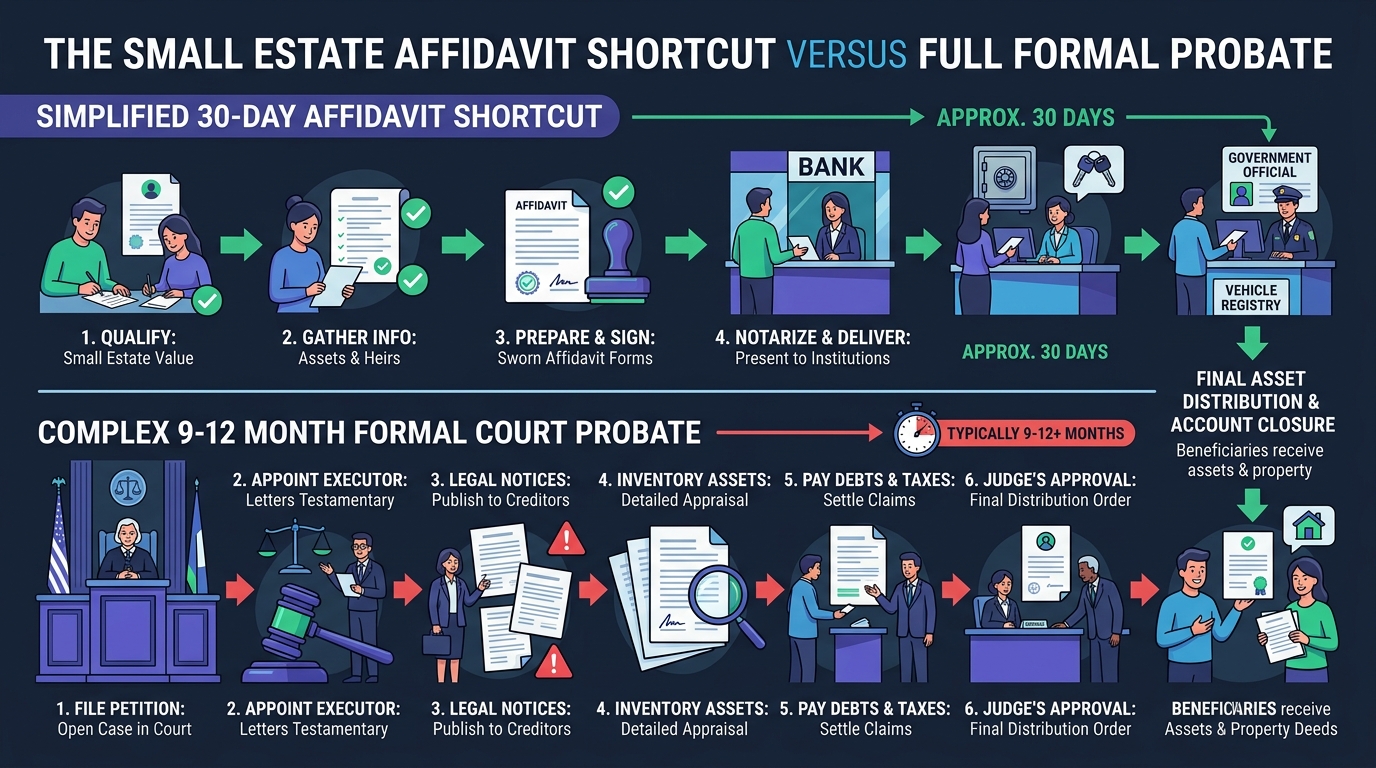
💡 Practical Scenario: Maria's Estate
Consider Maria, who passes away leaving an individual checking account with $18,000, a paid-off sedan valued at $8,000, no real estate, and no living trust. She forgot to add a Payable on Death beneficiary to her checking account.
State Specific Rules and Threshold Variations
Small estate statutes vary significantly across state lines. Here are three representative state frameworks:
Voluntary Administration
Available when the decedent held $50,000 or less in personal property. Excludes exempt family property like one vehicle up to $25,000.
Section 13100 Affidavit
Allows transfer of personal property without court if the total estate value is under the inflation-adjusted statutory cap (over $184,000). Requires a 40-day waiting period.
Virginia Code § 64.2-601
Permits collection of small assets up to $50,000. Mandates a strict 60-day waiting period after death before an eligible designated successor can sign.
6. How a Living Trust Works (and the Funding Rule)
A revocable living trust is a legal arrangement created during your lifetime. You (the grantor or trustmaker) maintain full control over the trust assets and serve as your own trustee. You specify who steps in as the successor trustee upon your death or incapacity, and outline exactly how property should be distributed.
🛑 The Number One Trust Mistake: Failing to Fund the Trust
Signing a beautifully drafted living trust document does not protect a single asset on its own. To avoid probate, your property must be formally retitled into the name of the trust. This means recording new deeds for real estate, retitling bank accounts, and updating business shares. If you leave your family home or brokerage account in your individual name, those assets must still go through probate court before passing to the trust via a pour-over will.
What a Living Trust Accomplishes:
- Bypasses Probate Court: Successor trustees distribute property privately without judge approval.
- Preserves Privacy: Unlike probate filings which become public records, trust terms stay private.
- Manages Incapacity: Your successor trustee can step in immediately if you suffer cognitive decline without court guardianship.
- Multi-State Efficiency: Avoids secondary ancillary probate cases if you own vacation homes in other states.
What a Living Trust Does Not Do:
- Does Not Erase Valid Debts: Creditors can still claim trust assets to satisfy legitimate debts.
- Does Not Eliminate Estate Taxes: Revocable trusts are transparent for federal and state tax purposes.
- Does Not Replace a Will Entirely: You still need a pour-over will to catch un-transferred property and name guardians for minor children.
7. Probate Costs, Timelines, and Legal Help
There is no universal national price for probate. Costs and timeframes vary widely depending on county court dockets, statutory filing fees, asset complexity, and whether heirs cooperate.
Initial petition filing fees, publication notices, and certified letters.
Hourly legal counsel, flat estate fees, or state statutory percentage schedules.
Licensed appraisal reports for real estate, business interests, or jewelry.
Required creditor windows, asset liquidation, and court accounting review.
Do You Need to Hire a Probate Lawyer?
You can often manage a small, uncomplicated estate without an attorney if the estate qualifies for a small estate affidavit, there is no real estate, debts are modest, and all family members agree. However, retaining an experienced probate attorney is strongly recommended if:
- The estate owns real estate, commercial buildings, or property in another state.
- The deceased owned an active business or partnership.
- Creditors are demanding large balances and the estate may be insolvent.
- Family members are arguing, threatening litigation, or challenging the will.
- You are concerned about personal fiduciary liability as executor or administrator.
8. Immediate Family Action Checklist
If a loved one has recently passed away, follow this step-by-step checklist before making hasty financial moves:
Frequently Asked Questions
Does having a will automatically avoid probate?
No. A will is actually designed to be filed with the probate court. It gives instructions to the judge on who should manage the estate and who should receive property, but it does not bypass the court process on its own.
Can a bank release funds without formal probate?
Yes. If the account includes a Payable on Death (POD) beneficiary, is owned jointly with rights of survivorship, is held inside a living trust, or meets your state's Small Estate Affidavit requirements, the bank can disburse funds directly.
Can you use a small estate affidavit for a house?
In most states, small estate affidavits are restricted exclusively to personal property like bank accounts and vehicles. However, certain states offer simplified real estate transfer affidavits for low-value real property. Always check local county probate rules.
Is a living trust better than a will?
They serve different needs. A will is necessary to designate guardians for minor children. A living trust allows property to transfer privately without court delays and manages assets during cognitive decline, but requires retitling assets during life.
Does joint ownership always avoid probate?
Not always. The title must state Joint Tenants with Right of Survivorship or Tenancy by the Entirety. Accounts or deeds held simply as Tenants in Common still require probate for the deceased person's percentage share.
Can an executor pay funeral bills before probate finishes?
Yes, funeral expenses and estate administrative fees enjoy top legal priority under state probate codes. Once legal authority is recognized, the representative can reimburse funeral costs from estate accounts before general debts are settled.
The Bottom Line for Families
Probate is a structured legal framework, not an automatic crisis. By taking time to identify how assets are titled, separating probate from non-probate property, and exploring small estate shortcuts, you can protect your family's time and financial resources. When in doubt, a brief consultation with a local estate attorney can provide tailored clarity for your specific jurisdiction.